Saturday, 14 December 2013

Taking Challenge Preparation to a Whole New Level


Having moved into a larger property a few months ago, it was past time to sort myself a decent hobby space. For years I've used the knackered Ikea dining table, setting up and packing away for each mealtime. While it meant I could watch/listen to TV and be with the wife at the same time, the recent delivery of a sizeable solid oak dining set had me search for a new location. Te new able is infinitely better for dining and entertaining, but it would be perilous for me to scratch or paint mark it.

I was originally allocated the loft. Seemed reasonable until I actually went in there in winter: its bracing, seemingly having been converted before silly ideas like insulation. Negotiations started over - where could I fit a long-term hobby space, without affecting our plans for the upstairs rooms? The second bedroom was the most credible, being quite large and with an odd space under the stairs to the loft.

The price of the wife's consent was acceptably low - I was welcome to a permanent hobby space there if I provided my assurances that I'd tidy projects away when we have guests staying so they can use the desk as a dressing table.

Deal. Off to Ikea we went. We unexpectedly returned with this corner desk, which barely fit into our car. But it fits perfectly in the space and gives a very good sized surface, as well as some pigeonhole storage for paint and current projects. I'll probably add some shelves above it for more storage. Truly large and temporary projects (terrain, probably) can still be done on the spare dining table, which has been relegated to the Baltic loft.


To be honest, I don't particularly like the look of it, it has an annoyingly structural shelf below so I can't fully stretch my legs out and white would have been the last colour I'd have chosen. Care to guess how many colours it comes in? Yes, one: white. But hey, it was cheap and should do the job admirably.


While in Ikea I had a bit of a moment at the storage boxes, coming back with somewhat more than the mere 6 I intended to buy. But this should allow me to rationalise the numerous cardboard boxes of terrain and supplies as well as the lead pile and store it all neatly in the loft. Win (or, I gained myself a massive job to do one coming weekend)


Of course, I also joined many of the challengers in the tradition of buying new brushes for the start of the challenge. This time I'm trying the Rosemary & Co Series 98 with triangular handles. Once again, delivered within 2 days, great service.


Tomorrow, I look forward to christening my new paint station.

Thursday, 5 December 2013

Dining Room Table gaming: 10mm Chain of Command

This weekend Gharak and I got together to try out the popular new ruleset 'Chain of Command' by Two Fat Lardies. We dug out my fairly extensive collection of 10mm WWII British to face his Germans. Rolling out a 2' x 4' mat on the dining table and playing in centimetres gave us well over the recommended board size, though terrain was a little scant.

First Game
We rolled 'Attack and Defend' with Gharak attacking with 10 support points. I got half that - eek!

The Jump Off Points

After the Patrol phase, Gharak seemed to be set up to attack one flank, with me occupying the village and hilltop we dubbed 'Hill 42'. Gharak's infantry quickly filled the hedges and woods around his jump off points, covering the hilltop with a worrying number of MG42s.

With the tree line quite exposed, I take to laying down smoke with my 2" mortar...


...to no avail, as my lead Section is cut to ribbons by the combined firepower of two full German sections, with the survivors thrown back in disarray.


German armour arrives! My support was a Staghound MkII armoured car, which though fast and packing a fair punch against infantry, was well outmatched by the Panzer IV.


The first German assault on the hill ends badly, shot down as they reached the tree line by the sheltering Brits, who spent a Chain of Command action to withdraw out of sight.


The Staghound takes a battering and while not destroyed outright, the Panzer's fire eventually forces its crew to bail out. Not ideal, though its tenacity stopped the Panzer from joining the attack on Hill 42.


A second wave of German infantry soon followed up the hill and an ill-judged counter assault by my Brits brought my morale to zero and game over. We found Close combat to be brutal on the attacker, best reserved for sweeping up pinned and routed units.

Second Game
We also got a second game in the following evening, Brits probing German lines. Gharak played very aggressively, seizing the table centre with sections split. Fearful of the MGs, I played cautiously, keeping more in reserve and used the lee of hills and woods to avoid any crossfires. Eventually, an assault down the far left flank and deploying a second section to threaten the same on the right forced Gharak to give chase to head then off, while I used a double-6 double turn to deploy from reserve and open up with my Vickers team on an exposed team. With his morale dangerously low, Gharak conceded he couldn't prevent me from reaching my objective on one or the other flank. One game each!

Closing thoughts
In Gharak's words: 'this was the ruleset we were looking for when we bought the 10mm WWII'. We last tried 'Baptism of Fire' second edition, which was fun and had a solid core but the rules were sometimes felt vaguely written meaning we spent lots of time conslting the book and trying to decide what the most suitable result would be. Both games feel quite realistic, but CoC is more streamlined and the rules are much easier to understand and remember. The CoC PDF is well worth getting as it is well-seeded with hyperlinks to relevant sections (I got the hardcopy rulebook too).

Chain of Command didn't suffer at all from being played in smaller scale and multi-based units made it easier to handle, if anything making deciding which units could see easier. Also, being able to throw a flocked mat down over the dining table after dinner was very convenient.
We found the two forces played slightly differently, Gharak splitting his sections into teams more often while ai kept mine together  and focused to focus firepower and avoid crossfires from MGs.
We had a quick tester before this game to thrash out the game concepts, which was worthwhile as

CoC introduces a few new mechanisms. I particularly like the pre-game Patrol Phase and slightly random activations, which simulate the fog of war without being too restrictive and force you to adapt your plan as evens unfold. We didn't find the Chain of Command points to be particularly powerful. Yet the core of the fighting are quite simple which is ideal for us playing infrequently, the similarities to Sharpe Practice are an advantage too!

All in all a very worthy addition to the rules stable, and one I think we'll play semi-regularly. I look forward to getting a few more games in - I'm eyeing up a small platoon in 15mm so I can grow down a few games at Wyvern Wargamers.

Saturday, 30 November 2013

Fun with Plastic Mahdists

I don't normally post WIPs, but was quite pleased by a recent afternoon spent hacking up the plastic Perry Mahdists. They're not quite finished and need some green stuff before priming, so are unlikely to roll off the painting queue for a couple of months.

First up, a chap manfully hurling his spear and one tweaked To be drawing his sword on the charge. The latter was damned fiddly, cue lots of teeth gnashing.


Next up, some tweaked command, simple hand swaps to add variety. The pole is loose and will be replaced by a Flag Dude banner in due course.


And finally a couple of casualties from the Anglo-Egyptian volleys. The one of the left came out particularly well with arm across his body and sword slipping from his grasp. The other didn't quite work so well. I've not decided whether to mix these into units for variety or start making casualty markers for my whole collection.


Great as the box is for making a large horde of Mahdists, I have found the of contents quite restrictive in post. But I do like converting plastics and finding fun uses for bits from a range of sources. I hope to knock a few more up before the Challenge begins.

I also made the trip to Wyvern Wargamers last weekend for a Russo-Japanese War game using the Lardies' 'Through the Mud and the Blood' rules. Hosted by Stu, we used his beautifully painted collection of miniatures. It was a well crafted scenario and a real hoot of a game, with the Japanese forces tasked with securing a bridgehead across a river by game end. Stu may well post fuller writeup on his blog, but I took a few snaps myself.

Japanese blinds push across the bridge.


Russian Cossacks, freshly painted and on their first outing, charge into Japanese infantry stuck in the open. The Japanese rout, but the charge comes at a high cost for the Cossacks. 


One last push to secure a bridgehead fails and with night closing, the Japanese withdraw


EDIT: And as if by magic, Stu more fulsome briefing and AAR is now up: http://dusttears.blogspot.co.uk/2013/11/russo-japanese-war-aar-3-forcing-river.html

Sunday, 24 November 2013

Time for a Small Dose of Miscellany

Every so often, I post up a selection of oddments that has worked is way off my painting queue. Here is one such post, not that I'm clearing the desks before the challenge starts, no sireee.

When Gharak and I were debating what to game next weekend, we came up with a twist on Pulp Alley, setting it slightly earlier in the 1920 and adding a Cthulu mythos twist, to tell the ghastly tale of what happened to the Professor's wife in a quiet english village. So off I merrily went to identify minis in the lead pile for a new Pulp Alley league. This giant of a chap is the first and was to be the village blacksmith. He is from the Blackwater Gulch western range. Alas, we've now decided of push around some WWII using the new and popular Chain of Command rules from TFL, so I'm not likely to finish the rest of them until we find a slot return to this genre.


The ever-enjoyable Pulp Alley rules do rely on randomly generated 'plot points' as narrative devices and in-game objectives. So I used some odds and ends that I had around to throw together my first few:


Perhaps a Hidden Camp and Missing Guard...

...and a Damaged Engine

Thursday, 21 November 2013

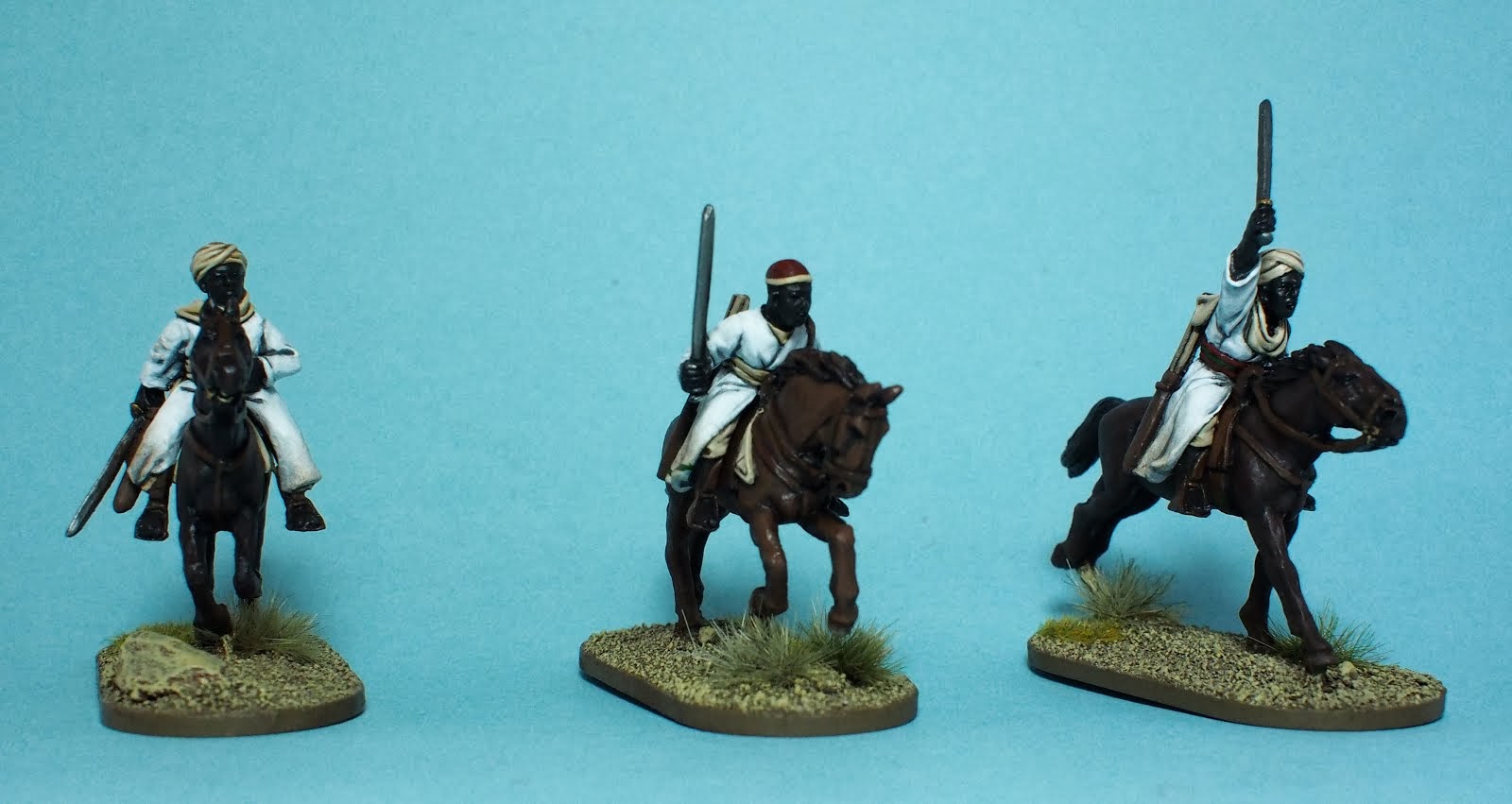
Sudan: Baggara horse

As we roll into winter in the UK, the nights have drawn in and I'm starting to find a little bit of hobby time to keep things ticking over. I've finally finished these Mahdist Baggara cavalry off, which have been cluttering up the painting table for a many months.


I found them a nightmare to photograph, these were the best of a bad bunch. They have such contrast between the very dark skin and white robes that I can barely get the skin to come out. However I tried to light them they were too dark or over-shiney, not helped by them not being Dullcote-d yet due to the wintry weather in the UK. But I am managing to get more depth of field. I'm pondering photography solutions (maybe even a lightbox!) and will probably have another go at photographing these some day.


This is the second of the last three units completed to give the 'bare minimum' games of Black Powder that I've played to date. The third, Egyptian infantry, is on the table now, I'm hoping to get them finished over the next fortnight. That just leaves command stands, oh and the many other units that have accumulated in the lead pile! I'm hoping to stay focused and make a big dent in all of that during the Challenge, with the ultimate aim of putting on a game at Wyvern Wargamers in a few months.


Unless you've been hiding under a rock this week, you'll probably have realised that the annual extravaganza, Curt's 'Analogue Hobbies Painting Challenge' is kicking off next month. I'm delighted to be taking part for the third time, as I find it a huge motivator to get things done, until the painting burn-out come March, of course! Like the other Challengers, the next few weeks will see me mulling over my points target, planning for the 'bonus rounds' and prepping as many minis as possible.

Sunday, 17 November 2013

A Quandary of Command

I'm new to Command stands, having gone with two fairly simple ones to start. so I'm looking to the wisdom of the blogosphere to help me with my latest composition. The second mounted British commander is quite a dynamic chappie waving his sword around - looks like he knows what he's doing so I imagine it is in the direction of the enemy.

But who would be a good fellow to accompany him? This businesslike bugler, a-bugling away?


Or someone more relaxed, mopping his brow?


Or perhaps a Sergeant yelling out orders?


Or another? I've this command pack available:


NB. The sharp eye-d among you may spot the latest painting off the queue lurking in the backgound - anyone think they can identify them? They'll be posted up later in the week. 

Sunday, 10 November 2013

Normal service will be resumed soon

Apologies for the lack of posts recently, hobby time has taken a back seat with my recent move, with plenty of unpacking and DIY to be done. A few weeks with no painting at all and I'm only just getting a little time for it. The endless trips to B&Q, Ikea and many others will be with me for months, as will the DIY as my wife and I work our way around the house. As if I needed a new project! 

On a slightly more hobby-related note, I recently caught a fascinating exhibition: 'Newseum' by the Times. It was a fairly small but interesting look at (UK-centric) journalism throughout the ages, touching on the Crimea, colonial conflicts, the discovery of Tutankhamun's tomb, conquering of Everest and onwards. 

The highlight for me being two of the telegraphs sent by Frank Powers during the siege of Khartoum. Including this one, to be hand delivered after the telegraph line was cut. If you look carefully, you can see it was annotated with 'send this' and signed by General Gordon. Apparently, it didn't make it though the Mahdist blockade and was found years later, stuffed in the walls of a hut. It's significance was realised and it was eventually received by The Times in London in the 1890s. The Times archive must be full of such fascinating snippets from history. 


Unaware of the no photography policy, I caught just the one snap before I was politely but firmly told to stop. 

Frank Powers himself was killed in September 1884 alongside Gordon's assistant Colonel Stewart when a group tried to break the blockade around Khartoum aboard the Steamer Abbas. The attempt failed when the Abbas ran aground and all passengers and crew were killed in an ambush. 

Finally, I had the good fortune to visit Wyvern Wargamers the other week and managed to get a game of Chain of Command in 15mm. Stu, Paul and the rest made me feel very welcome and I definitely intend to visit as often as I am able.