Thursday, 8 November 2012

Sudan: Mahdist reinforcements

My last post showed the British and Egyptian forces so far. While I already had a number of Ansar finished during Curt's painting challenge, I did add a few to supplement those. First up, I made up some more of the Perry plastics, this time as Beja tribesmen or 'fuzzy-wuzzies' (the nickname derived from the quite excellent hair they sport...). These will tend to be represent more elite warriors in game. These were painted in the same way as before, which is really quick to do and effective to get very dark African skin tones. 


I couldn't resist these camel-riders either. Great miniatures, they will be mobile and pack quite a punch. The above are loosely painted as dismounted versions of each. Perry Miniatures once more. 


A few of you commented you were looking forward to the project developing. Well, that's it so far, this was a little skirmish side-project and was never meant to take over. I'm quite pleased I painted everything to be honest!  I have some terrain I may do more work on and write up and AARs to post. But this is the most of it for now!

 Though, as I am a bit 'ooh, shiney', I would quite like a few more packs, which I may pick up here and there...

Monday, 5 November 2012

Dear Santa...


Ian over at The Blog With No Name is kindly running a gamer blog 'Secret Santa' for Christmas this year. Which is a smashing idea - who doesn't like presents, particularly gaming-related ones that our loved ones won't buy us! Assuming Royal Mail get the parcels to everyone, of course!

I'm aware that I have somewhat electic tastes and flit around projects a lot and  in'real life'  I'm  accused of being difficult to buy for (not true!). So thought I'd give my Santa some ideas by way of things I've recently had my eye on. 

First up, some reinforcements for my Napoleonic Spanish. To be a standalone force, they could do with some cavalry. I reckon the Perry French hussars would be perfectly serviceable as 'Maria Luisa Hussars', though a whole box is a squeeze out of budget. 


Don't they look dapper?


Another option would be to start another unit of infantry. I've been very tempted by the new Offensive Miniatures line as they seem very well matched to Perry, unlike Capitan who are a bit scrawny. I do like the bearskins on those Grenadiers, though the Line are the classic Spanish look.

The recently revealed Secret Project would also benefit from a couple of packs. Ive been using the Perry Miniatures Sudan range, many lovely models there, but I particularly fancy these packs:

British infantry firing line
10th Hussars swords drawn
Bashi Bazouks on foot skirmishing (above, nice to get some colour on the battlefield)
Sudanese Baggara Horse with spears

Another thought, my Saga Viking force could do with another unit of Bondi to round it out. Gripping Beast do a perfectly sized pack, and are nice minis to boot! 


I hope that's useful, Santa, unless you've got some ideas already...

Saturday, 3 November 2012

The Secret Project: Revealed!

I've not been doing that much hobby stuff recently, mostly as my hobby time has been eaten into by some quality time with the PS3 (mostly the excellent and damnably addictive Batman: Arkham City) But, to keep the post rate up, I thought I'd do a series of posts to this summer's Secret Project. 

You may recall there were a few clues:
-small scale narrative campaign using Brink of Battle
-miniatures by a preferred manufacturer
-I already had one force painted (well, most of it) 
-some of the minis would find a dual use in Pulp scenarios. 

So, imagine yourself in Egypt, 1883. Egyptian-held Sudan is in turmoil. El Mahdi has emerged and gathered his 'Ansar' around him: the tribes Korfodan, Beja and Nile Arabs. Yup, is time to dabble in Colonials! Much inspired by forums as wells as blogs such as 'Maiwand Day' and 'Horse and Musket',  it was a small-scale and entertaining painting distraction. 

First up, some Egyptian Infantry (Perry Miniatures):


I tried a new flesh tone on these and think it came out quite well. I reckoned they will be serviceable as North/African or Turkish military/paramilitary types for 1930s Pulp. 


Next, pith helmets galore, it's the stalwart British infantry (Perry miniatures)


Painted as King's Royal Rifle Corps (KRRC) from the incredibly useful Perry miniatures painting guide here. 


Another mini from the pack above, painted in a khaki uniform, he serves as character for the campaign (more on that later) this would be Sir Henry Huffington (he is actually a stand-in for Huffington, as there is more suitable figure I've got my eye on...). I put him on a beveled base as he also join my 28mm Pulp characters on some adventures, as a further well-traveled friend of the Professor. 


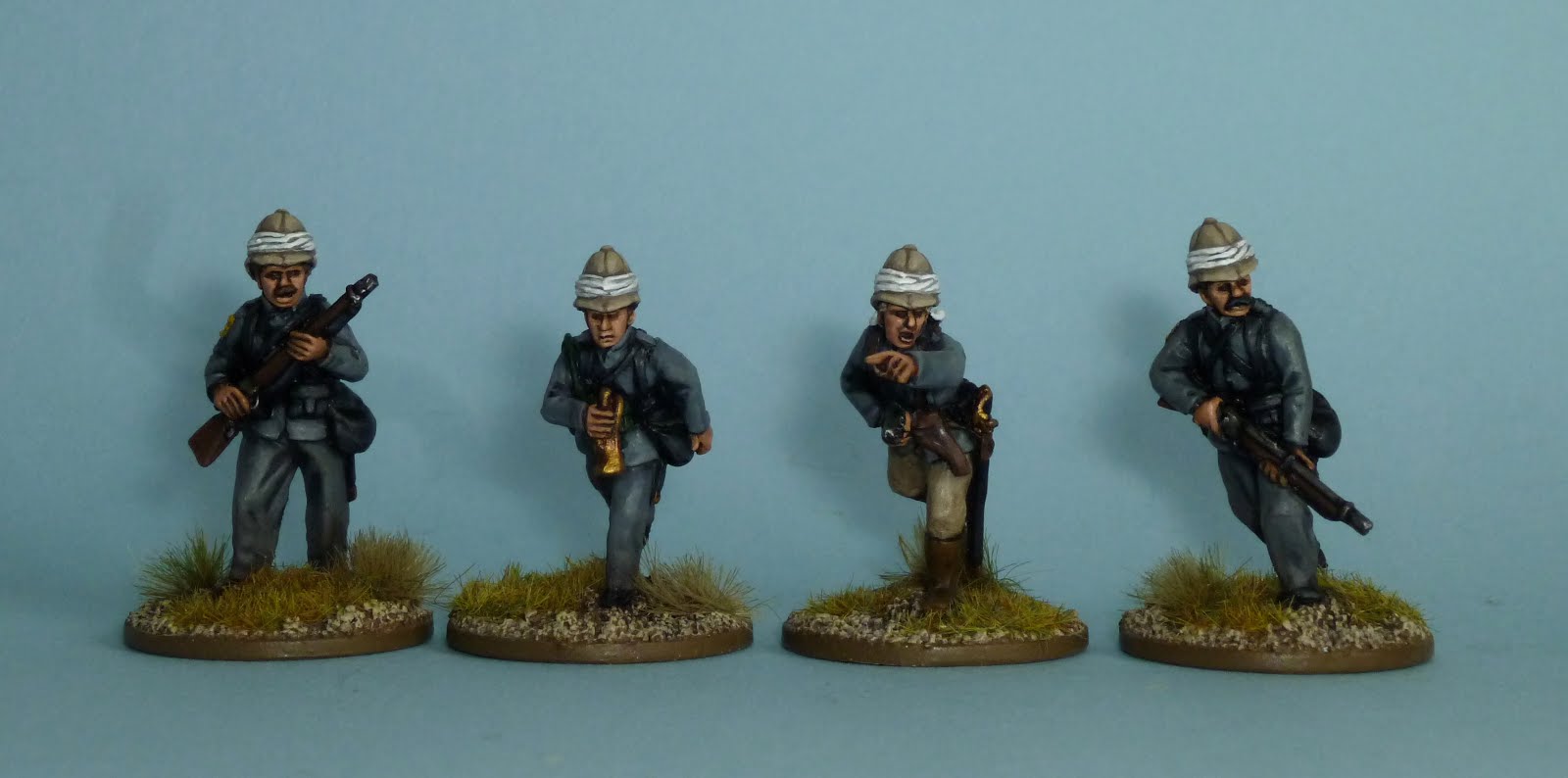
And finally, some members of the Naval Brigade running at trail (guess what...Perry Miniatures!) 

Sunday, 28 October 2012

Sharp Practice - Encounter in the Peninsula

Samulus came over for a game yesterday and I whipped out an old favourite of mine: 28mm Napoleonic Peninsular War using slightly modified Sharp Practice rules. I've built up a fair amount of terrain for rural Spain and could field British against Spanish, though the latter were intended as allies rather than antagonists. So I was making do without any French, and did have to knock up some cards for the activation deck. 

As this was Samulus' first game, and my first of Sharp Practice for over a year, I kept it simple. A meeting engagement with small, balanced infantry forces. Each force had four units led by one Grade 3, one Grade 2 and two Grade one leaders. Of the units, one was  Light infantry, one 'Good' grade infantry and one 'Poor' infantry, though I shuffled around the leaders across each force. The objective was simple - small forces encounter each other in a rural region and to retain the field both aim to take and hold three defensible positions conveniently placed across the centre of the table.

Game start, and the colourful Spanish Blinds face off against the British in the opposite corner. The objectives were the farmhouse, church and walled wheat field. 


A couple of turns passed and I had rotten luck with the activation deck, with my Blinds activation only coming out once in three turns. This limited my movement and kept me in my starting corner while Samulus' Brits bounded across the table. On turn three, the Blinds were all spotted and the gloves came off. My infantry were exposed, with the well led, Good infantry in the centre took three volleys without getting chance to respond, leaving them in a bad way. The second unit safely made it to the wheatfield. 


The British put out a withering fire, forcing back the battered line infantry, by now on the verge of quitting the field. The Spanish in the wheatfield fare much better so I chose to push the poor Militia unit into the field aswell to take advantage if the cover. Things aren't looking good for the Spanish. 


I managed to rally my Centre, while the Lights took shelter in the wooded terrain to their left. 


These exchanges continued, with the most notable and surprising even being a large unit of British infantry charging battered Spanish line, who managed to repel and break them. Superior quality and command and some luck with the dice was telling. 


Meanwhile, the Militia finally make it to a position to put the 95th Rifles under fire. While they weren't that effective on the day, I do find Rifles can be  a pain, with a long range and accurate fire. 


The Spanish centre eventually broke the British to their front and sent their greatcoated light infantry off in search of the third objective. But in their state they faced no real chance of shifting the fresh Highlanders who held the Church. The Line in the wheatfield were in an exchange of attrition, as were the Militia and Rifles. The balance had shifted.


The field at game end, turn 8. Each side holds one objective, the walled field for me, and the Church for the Brits, while the third is neglected by both. Each side has taken a roughly similar level of casualties and neither of us had any great prospects of shifting the other. A draw, it seems! 


Once more, I enjoyed Sharp Practice. It had a nice level of complexity, with some attempt to model the fog of war using blinds and random activations. But it isn't too random, as units whose command card hasn't been drawn are able to take limited actions on the 'Tiffin' (or end turn card - bless the Lardies and their terminology). It does a perfectly good job of making a fun game with twists and turns, which feels right for the era and plays in two to two and a half hours. 


As I packed down, Samulus and I discussed what scale of clash the game is representing: 1:1 or up to each unit representing a company or two. This triggered by the fact each unit is modelled with their Colours, which they obviously wouldn't be in a skirmish like this. I remain content with keeping such things undefined as long as the game is fun, feels right and looks good. And they do look good carrying their Colours, if I do say so myself. 


Hopefully we'll get chance for another game soon, perhaps with some cavalry and artillery to mix things up. 

Wednesday, 24 October 2012

Napoleonic British Regimental Colours


I finished fixing these Flag Dude Regimental Colours to the bearers over the past few days. I picked them up at Salute on so many months ago so it was well past time. They were already painted but needed a little touch-up work after my not-so tender ministrations with scalpel and drill. Also interesting: you can see my painting has changed in the 2 years I've been doing Naps - the chap on the right was first and the red jacket, sash and flesh are all markedly different to the other two.

The poles are all the same length. Honest!

And a shot of one full unit, because, well why not!


Saturday, 20 October 2012

Back to Napoleonics: 2nd Life Guards

So a few weeks ago that brother of mine Gharak (he of many hobbies) proudly declared he was going to clear his painting desk and get back to it, after many months of distraction. Much to my shock, he declared he would work on some Napoleonics. I was stunned (and sceptical, I must admit).

Well, I'm shuffling around projects at the moment, so it wasn't too much of a problem for me to dig out some prepped Napoleonics to match him. Its been a good nine months since I last did any, which was a nice break. And voila: the first batch of a new unit of British cavalry. 


Yup, they are the creme de la creme of the British army: the Household Cavalry's 2nd Life Guards. Some Heavies to crush my brothers lighter Dragoons and Lancers. Let's hope he has a box of Cuirassiers hiding somewhere!

Ok, only four of them. They look a bit lonely, I should get cracking on batch two!

They are Perry metals. I found them much less frustrating to paint than my last Napoleonic cavalry, some Light Dragoons. Probably as I sprayed the troopers white separately from the black horses, so no white-ing out was required, unlike the piping, facings and straps of the balck-undercoated Dragoons. Awful job, that was. In comparison, these were finished off relatively quickly. I'm surprised actually, as I normally hate painting cavalry. 


A note on Historical accuracy: both regiments of the Life Guards did serve in the Peninsula from 1812, though they spent many months in Lisbon on ceremonial duties. They saw some limited action at Vittoria and San Sebastian, neither of which being the sort of game I'm trying to recreate using Sharpe Practice. The large skirmishes are more suited to the scouting and harrying abilities of the lights! The Life Guards were shipped back to Britain from 1814. These Perrys are of course meant for the Waterloo campaign, so the uniforms might be a bit off, but my limited research hasn't highlighted any major changes. 


On both service and uniforms I'm not so fussed, anyway, the models are too lovely for historical accuracy get in the way of me using them. You may also note the lack of tarletons on my Light Dragoons, also being Perrys meant for a few years later... As mentioned before, I'm a contented member of the 'what-if' club of historical gaming.


And Gharak? I queried his progress a week later. He had cleared the table, unpacked miniatures and paint...and promptly put them away again. Ah well bro, nearly there! 

UPDATE: Gharak has finished a Napoleonic French unit this week, having seen the evidence I take it back! 

Wednesday, 17 October 2012

Short review and painting: Sarissa Precision Adobe Cantina

For the Secret Project, I bought a couple of the Sarissa Pecision Old West adobe line. I figured they were useful for a whole host of different games. The centrepiece was this two-story cantina. These are the bits out of the packet: basically, lots of precision-cut wood and a small instruction sheet.

I made two initial choices: to paint it unassembled (which is rare for me) and to leave the wooden boards the colour they were. So I started by dong a quick dry assembly to figure out how it went together before spraying everything that wasn't to be wood lightly with white spray primer. I split the walls into two batches to paint. Stage one was to pick out the brickwork in watered Vallejo 'Earth'. I used different consistency of paint and brushed it on lightly to give a varied texture. This avoided me doing any highlighting, but I may go back and dry brush some lighter shades on to reduce the contrast between the two colours. Stage two was to use watered down Vallejo 'Buff' on the lower portions of the walls and going up where walls would adjoin each other and other shaded areas (like around the beams). Here we are at stage two of the first batch:

Moving on, the walls got three highlights with 'Buff' mixed with white, up to a just off-white at the very tops. At all stages, I kept the paint quite thin to speed up the painting.  

Assembly now. I started off with superglue - don't bother! White glue works much better. The pieces all fit very snugly together. In fact, they can take a bit of jiggling and force to get them into the slots. I was a bit worried about breaking the thin pieces, but didn't so they much be quite sturdy. Getting them to fit in the right order is sometimes tricky, so test each piece before gluing.

Part assembled, I used elastic bands to hold the walls in while the glue dried. Probably not necessary, but a bit of a precaution.


And here we are assembled from the back and front. Quite an impressive building for its size. It also came with a ladder for roof access and I cut the doors out and mounted them on balsa-wood to make them openable. The kit was £18, a very reasonable price I thought!


I left off some of the window shutters of mine, but may add them later. You may notice that the second floor doesn't sit right from the back. For some reason the 'pins' holding the second floor on res on the beams rather than in the slots. So while everything else out of what was a pretty complex kit fit perfectly, these didn't. I emailed Sarissa these pics and they couldn't explain it either - apparently other kits in stock were fine and apparently I'm told I hadn't fudged the assembly either! Perhaps they were just being nice. Sarissa sent me another kit by way of apology - so full marks for customer service. In fact, service was impeccable, my order was dispatched very quickly and questions were answered promptly. With the price and custome service, I wouldn't hesitate to use Sarissa again, even among the booming laser-cut terrain market. Rather than leaving the unsightly gap, I fixed the issue with my kit by just clipping off the tags and filling in the slots with discarded tags. This worked fine and those particular noggins didn't seem important structurally - the rest of the structure, particularly the internal walls holds the second floor on.